
 Cart is empty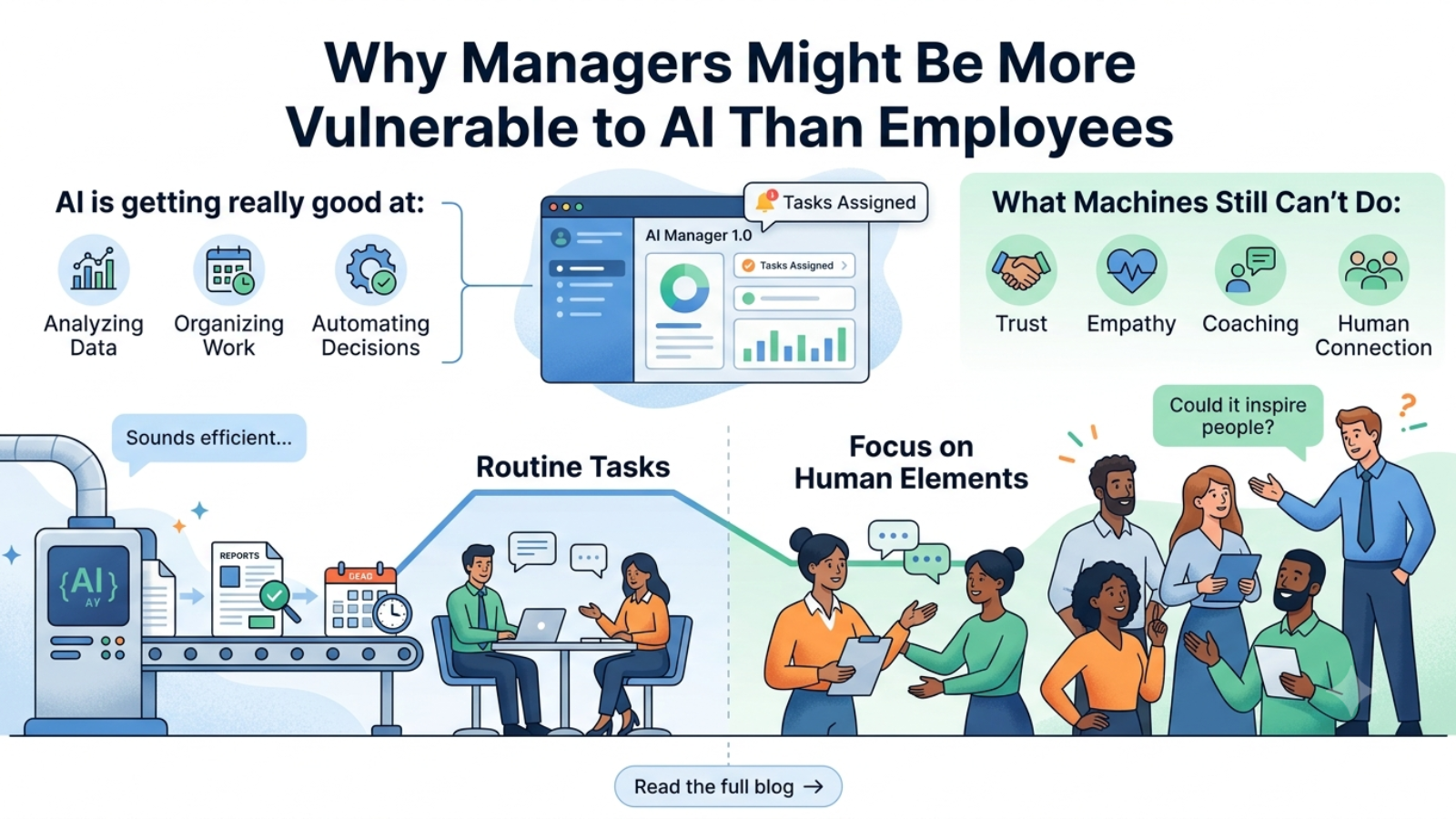
For years, employees have been hearing the same warning:
“AI is coming for your job.”
The customer service representative got worried.
The data entry clerk got worried.
The graphic designer got worried.
The IT support engineer got worried.
Everyone started wondering:
“Will AI replace me?”
But there’s another question that doesn’t get as much attention:
“Could AI change what managers do too?”
And honestly…
The question is more interesting than it first sounds.
Managers spend a surprising amount of time reviewing reports, tracking deadlines, scheduling meetings, analyzing performance, and making routine decisions.
AI can already help with many of these tasks.
So the future may not be about AI replacing managers completely.
It may be about AI changing what managers actually do.
Why Employees Fear AI
Most discussions about AI and jobs focus on employees.
People worry that AI could affect roles such as:
- Customer support
- Data entry
- Accounting
- Software development
- Analysis
- Content creation
- Administrative work
AI can process large amounts of information quickly, identify patterns, generate content, summarize information, and automate repetitive tasks.
That makes some employees nervous.
But let’s flip the question.
What happens when the same technology starts helping managers?
What Do Managers Actually Do?
Before we ask whether AI could replace managers, let’s look at what managers actually spend their time doing.
A typical manager may:
- Review reports
- Assign tasks
- Monitor performance
- Schedule meetings
- Approve leave requests
- Create plans
- Track deadlines
- Prepare presentations
- Analyze team results
- Communicate with employees
Now think about it.
How many of these activities involve organizing information, tracking progress, or making decisions based on data?
That’s where AI can potentially help.
AI can organize information, identify patterns, summarize reports, and support data-driven decisions.
Not Every Manager Does the Same Job
It’s also important to remember that managers are not all doing the same work.
An IT manager may manage technology projects and security.
A sales manager may focus on customers, revenue, and targets.
An HR manager may deal with employees, recruitment, and workplace policies.
An operations manager may focus on processes, resources, and deadlines.
Because of these differences, AI won’t affect every management role in the same way.
The more a role depends on repetitive administrative work and structured data, the more opportunities there may be for AI to assist with those tasks.
Roles that depend heavily on leadership, negotiation, mentoring, conflict resolution, and human relationships are harder to automate.
Imagine an AI Manager 😭
Let’s imagine your company introduces:
AI Manager Version 1.0
Monday morning.
You arrive at work.
Instead of receiving a long meeting invitation, you get a notification:
“Good morning. Based on workload analysis, your priority tasks have been assigned.”
No meeting.
No long discussion.
No motivational speech.
Just tasks.
Half the employees would be impressed.
The other half would immediately start updating their CV.
😭
Of course, this is an exaggerated example.
A more realistic future is an AI-assisted manager—a human manager using AI to organize work, analyze information, and make routine tasks easier.
The Meeting Situation
Let’s be honest.
Many employees secretly wonder:
Do we really need all these meetings?
Imagine AI analyzing:
- Project updates
- Team status
- Deadlines
- Outstanding tasks
Then it sends:
“Meeting unnecessary. Continue working.”
Productivity immediately increases by 300%.
Okay…
Maybe not 300%.
But some employees would definitely celebrate.
AI could help managers identify which meetings are necessary and which updates could simply be summarized in a message.
That could give managers more time to focus on actual leadership.
The Performance Review
Traditional manager:
“Let’s discuss your performance over the last year.”
AI-assisted manager:
“You completed 96% of assigned tasks, improved response time by 18%, and resolved 47 issues faster than the team average.”
No long spreadsheet.
No searching through old emails.
Just a summary of the available data.
But here’s the important part:
Data does not automatically equal fairness.
AI can help managers analyze performance, but the quality of the data matters. If the data is incomplete or the system is poorly designed, the results can also be misleading.
A human manager still needs to understand the context behind the numbers.
The Office Politics Problem
One reason people joke about AI managers is that AI doesn’t have personal relationships in the same way humans do.
AI doesn’t:
- Have personal friendships with employees
- Join workplace gossip
- Hold personal grudges
- Get impressed by the loudest person in a meeting
In theory, data-driven decisions could reduce some forms of human bias.
But AI isn’t automatically unbiased.
AI systems can reflect problems in the data, rules, or processes used to create and operate them.
So replacing human judgment with AI doesn’t automatically solve workplace politics.
It simply changes the way decisions are made.
But Here’s the Problem
Managing people is not just about numbers.
People are not Excel spreadsheets.
Employees have:
- Stress
- Family responsibilities
- Personal challenges
- Emotions
- Different working styles
- Career goals
Sometimes a team member doesn’t need another performance report.
They need someone to listen.
And that’s where human leadership remains important.
Imagine Requesting Leave From AI
Employee:
“Can I take leave? My child is sick.”
AI:
“Request analyzed. Leave balance available. Approved.”
Efficient.
But a human manager might ask:
“Is everything okay?”
That small conversation can matter.
AI may be able to process a leave request.
It cannot automatically understand every human situation behind that request.
Leadership Is More Than Task Management
The best managers don’t simply manage tasks.
They also:
- Motivate teams
- Build trust
- Resolve conflicts
- Coach employees
- Develop talent
- Handle difficult conversations
- Support people during challenging situations
- Help employees grow
These skills involve judgment, communication, empathy, and relationships.
AI can assist with some parts of management, but these human responsibilities are much harder to automate.
This is also why human skills such as communication, teamwork, and problem-solving remain important as technology changes the workplace.
The Funny Reality
Let’s be honest.
Some employees reading this are thinking:
“My manager already behaves like a robot.”
While some managers are thinking:
“My employees would definitely replace me with AI if given the chance.”
😭
The reality is probably somewhere in the middle.
AI isn’t necessarily coming to take the manager’s chair tomorrow morning.
But it can change what happens in that chair.
What AI Could Automate in Management
The more realistic scenario is that AI will automate or assist with parts of management, rather than replace managers completely.
For example, AI can potentially help with:
- Scheduling meetings
- Generating reports
- Tracking performance metrics
- Managing calendars
- Creating summaries
- Analyzing productivity data
- Organizing project information
- Identifying overdue tasks
- Summarizing employee feedback
These tasks can consume significant amounts of management time.
If AI handles more administrative work, managers may have more time for people-focused responsibilities.
The Future Manager Might Look Different
The manager of the future may work alongside AI.
Instead of spending hours:
- Creating reports
- Updating spreadsheets
- Tracking deadlines
- Searching through documents
- Summarizing meetings
They may spend more time:
- Coaching employees
- Solving problems
- Developing talent
- Building relationships
- Making important decisions
- Managing change
In other words:
AI may reduce administrative work without eliminating human leadership.
And managers who learn how to use AI effectively may become more valuable, not less.
The Plot Twist
Here’s the funny twist nobody talks about.
Many employees fear AI replacing jobs.
But AI is also creating new expectations for managers. This is part of a wider change in the workplace, where AI, hiring trends, flexible work, and other global developments are affecting careers.
Managers who mainly:
- Forward emails
- Schedule meetings
- Approve routine requests
- Prepare basic reports
may face more pressure as AI makes some of those tasks easier to automate.
That doesn’t mean those managers will automatically lose their jobs.
It means their value may increasingly depend on what they can contribute beyond routine administration.
The managers who adapt may spend less time managing paperwork and more time managing people.
And that could actually be a good thing.
So… Will AI Replace Managers Before Employees?
Probably not completely.
There is no simple rule saying AI will replace managers before employees—or employees before managers.
Different jobs contain different tasks, and some tasks are easier to automate than others.
The more realistic future is:
Employees + Managers + AI
working together.
AI handles some repetitive work.
Employees use AI to improve productivity.
Managers use AI to make better-informed decisions.
And humans remain responsible for judgment, relationships, leadership, and accountability.
At least…
That’s the optimistic version. 😭
What Should Managers Do Now?
Managers don’t need to become AI engineers.
But they need to understand how changing technology is affecting modern hiring and recruitment.
They can start by:
- Learning useful AI tools
Understand which tools can help with reporting, research, communication, and productivity. - Automating repetitive work
Look for routine tasks that consume time but don’t require human judgment. - Improving human skills
Communication, leadership, coaching, critical thinking, and conflict resolution become more important when routine work becomes easier to automate. - Learning to question AI output
AI can make mistakes. Managers should verify important information before making decisions. - Helping employees adapt
Good managers should help their teams learn how to work with new technology rather than simply telling them to “use AI.”
Final Thought
For years, employees worried that AI would replace them.
Now the conversation is becoming more interesting.
AI isn’t only changing employee roles.
It’s changing management too.
The biggest change may not be who gets replaced.
It may be what people spend their time doing.
Routine tasks can increasingly be supported by technology.
That means employees and managers may need to spend more time on the things technology cannot easily reproduce: judgment, creativity, communication, leadership, empathy, and human connection.
Whether you’re an employee or a manager, the safest approach isn’t to compete against AI.
It’s to learn how to work with it.
⭐ The Moral
AI can organize work, analyze data, and automate tasks. But trust, empathy, leadership, and human connection are still difficult to replace. The future belongs to people who can work effectively with AI while bringing valuable human skills to the workplace.
Frequently Asked Questions
Can AI replace managers?
AI is more likely to automate or assist with specific management tasks than replace managers completely. Leadership, mentoring, conflict resolution, and relationship-building still require significant human judgment.
Which management tasks can AI automate?
AI can assist with reporting, scheduling, data analysis, meeting summaries, performance tracking, calendar management, and other routine administrative work.
Will AI replace employees before managers?
There is no universal answer. AI affects different jobs differently depending on how much of the work can be automated and how much depends on human judgment, creativity, or relationships.
What skills should managers develop in the AI era?
Managers should strengthen communication, leadership, coaching, critical thinking, problem-solving, adaptability, and the ability to use AI tools responsibly.
🤔 Be Honest…
If your company announced tomorrow:
“Your new manager is AI.”
Would you be:
👍 Excited
😅 Nervous
😭 Updating your CV immediately
Share your answer in the comments!
Leave A Comment