
 Cart is empty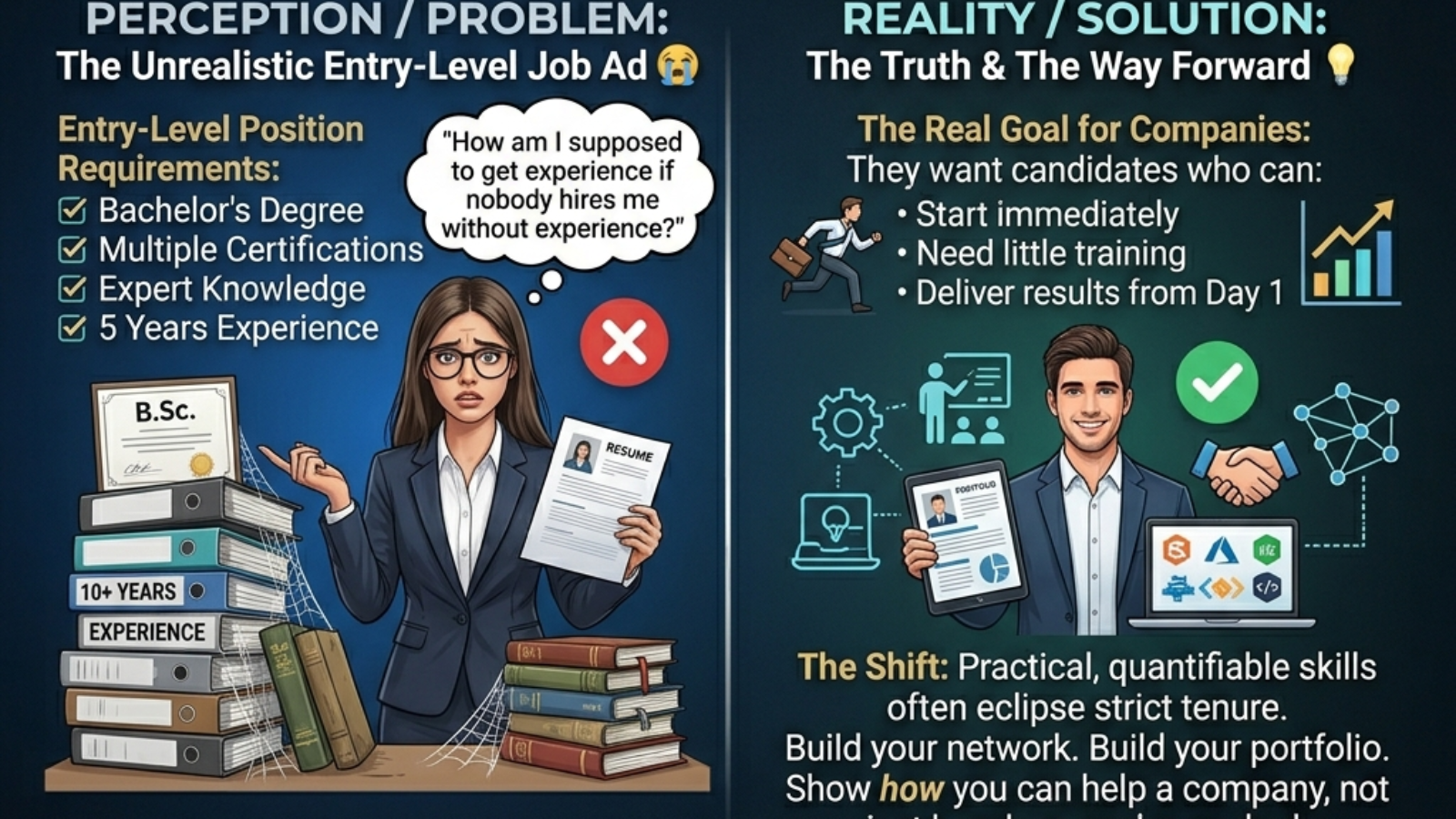
Have you ever seen a job advertisement that says: Entry-Level Position
Experience Required: 5 Years
And immediately wondered:
“So… when exactly was I supposed to get those 5 years?”
Before college?
In a previous life?
During summer vacation?
If you’ve ever searched for jobs online, you’ve probably experienced this confusion.
And honestly, it’s one of the biggest frustrations for job seekers today.
Especially fresh graduates.
The Great Job Market Mystery
Imagine this.
You finish your studies.
You spend years:
- Attending classes
- Completing assignments
- Taking exams
- Earning certifications
You finally graduate feeling excited.
Then you open a job portal.
The first job you see says:
Junior Position
3-5 Years Experience Required
At that moment, every graduate experiences the same emotion:
😭
The Question Everyone Wants Answered
How do you gain experience…
If nobody hires you without experience?
It’s the career version of:
You need a key to open the door, but the key is inside the locked room.
Why Companies Ask for So Much Experience
Let’s be fair.
Companies are not always trying to make life difficult.
Many businesses are under pressure.
They want employees who can:
- Start quickly
- Require less training
- Solve problems immediately
- Handle responsibilities independently
From their perspective:
Hiring someone with experience feels safer.
Less risk.
Less training.
Less uncertainty.
At least that’s the theory.
The Problem? Everyone Wants the “Ready-Made Employee”
Companies often want someone who:
✔ Has experience
✔ Has certifications
✔ Has technical skills
✔ Has communication skills
✔ Can join immediately
✔ Accepts the offered salary
Basically:
They want a senior employee for a junior position.
The Fresh Graduate Reality
Fresh graduates face a strange situation.
Employers say:
“You don’t have enough experience.”
Meanwhile graduates are thinking:
“That’s exactly why I’m applying.”
Everyone starts somewhere.
Nobody is born with 5 years of experience.
Even the most experienced professional was once a beginner.
The Internship Paradox
Then comes another classic problem.
Students complete internships.
Volunteer projects.
Freelance work.
Personal projects.
But during interviews they hear:
“We’re looking for real experience.”
At this point candidates start wondering:
“Then what was all that effort for?”
Job Descriptions Have Become Wish Lists
Here’s a secret.
Many job descriptions are not actual requirements.
They’re wish lists.
Imagine ordering coffee and saying:
“I’d like the perfect coffee, perfect weather, a salary increase, and world peace.”
That’s how some job descriptions look.
Companies write down everything they would love to have.
That doesn’t always mean every requirement is mandatory.
The AI and Application Problem
Today’s job market is different, and modern hiring and recruitment has become increasingly focused on filtering large numbers of applications quickly.
Companies receive hundreds or even thousands of applications.
So they add:
- Experience requirements
- Certifications
- Skill requirements
Not always because they’re necessary.
Sometimes it’s simply a way to reduce the number of applicants.
It’s basically a giant filter.
Unfortunately, many capable candidates get filtered out too.
UAE Job Seekers Know This Very Well
In the UAE, competition can be intense.
A single vacancy may attract hundreds of applicants.
Recruiters often receive CVs from:
- Fresh graduates
- Experienced professionals
- Career changers
- International candidates
This is why understanding how recruiters and your CV fit into the hiring process can help job seekers make better applications.
Experience Doesn’t Always Equal Skill
Here’s something companies sometimes forget.
Five years doing something poorly is still five years.
Meanwhile another person might learn more in one year through:
- Training
- Certifications
- Practical projects
- Personal dedication
Experience matters.
But experience alone doesn’t guarantee ability.
The Candidates Who Never Apply
This creates another problem.
Many people see:
5 Years Experience Required
And immediately stop applying.
Even when they actually have most of the skills needed.
Studies and recruiters often suggest that strong candidates should still apply when they meet most of the requirements.
Because job descriptions are often more flexible than they appear.
What Job Seekers Can Do
Instead of focusing only on years of experience, job seekers should also understand what hiring managers are looking for.
Focus on building evidence.
Show:
- Certifications
- Personal projects
- Freelance work
- Volunteer experience
- Portfolio work
- Practical skills
Employers love proof. But getting past the application stage is only the beginning. You also need to prepare for job interviews so you can explain your skills, experience, and achievements clearly.
Sometimes proof matters more than years.
The Funny Truth
Let’s be honest.
Sometimes job ads feel like this:
Entry-Level Position
Requirements:
- 5 Years Experience
- Master’s Degree
- 17 Certifications
- Expert Knowledge of Everything
- Ability to Work Under Pressure
- Salary: “Competitive”
Translation:
“We’re still figuring out what we actually need.”
😭
The Good News
The job market isn’t impossible.
Many companies still hire:
- Fresh graduates
- Career changers
- Junior professionals
Because smart employers understand something important:
Skills can be taught.
Attitude, curiosity, and willingness to learn are much harder to find.
Final Thought
The famous “5 years of experience for an entry-level job” requirement has become one of the biggest jokes in modern recruiting.
But behind the joke is a real challenge facing millions of job seekers.
Companies want experience.
Candidates need opportunities to gain experience.
And somewhere in the middle, both sides are trying to solve the same problem.
⭐ The Moral
Every expert was once a beginner. If companies only hire experienced people, where will the next generation of experienced professionals come from?
🤔 Be Honest…
What’s the most unrealistic job requirement you’ve ever seen?
Was it:
😭 5 years of experience for an entry-level role?
OR
😅 Something even worse?
Share your experience in the comments!
Leave A Comment